2026 Healthcare Hydration Statistics UK: Standards, Safety, and Sustainability Image

Water Dispenser Concerns in Offices and Hotels: The Clear Answer Guide

Choosing, installing, and maintaining a water dispenser for office or hotel use sounds straightforward, until the equipment goes down mid-morning, a hygiene audit raises questions, or a bottled water delivery fails to arrive. For facility managers responsible for multiple sites, these are not abstract risks; they are operational realities with real consequences for client satisfaction and your own reputation. This guide addresses the concerns that matter most: hygiene standards, equipment reliability, cost justification, and sustainability. Whether you are reviewing your current setup or procuring for a new site, the answers here are grounded in practical experience and evidenced performance.

Key Takeaways

  • Mains-fed dispensers eliminate bottle-swap disruption and can reduce carbon footprint by up to 86% versus bottled water.
  • ThermalGate comes as standard on BRITA systems and helps keep the point of dispensing safe between service visits. 
  • PureProtect, smart BRITA Firmware on hot water systems, the Digital Product Assistant Tool, and BRITA’s direct service model all help reduce avoidable downtime and keep systems running reliably.
  • Both buy and rent options are available, with tailored consultation to match your budget structure and procurement requirements.
  • The full product range covers offices, hotels, healthcare facilities, and other high-footfall commercial environments.

Why Facility Managers Are Rethinking Their Office Water Setup

The shift away from traditional bottled water coolers and point-of-use systems is accelerating, and it is being driven less by trend than by operational frustration. Facility managers managing multi-floor offices, hotel properties, or mixed-use commercial environments are increasingly finding that legacy water solutions create more problems than they solve. Office water dispenser problems ranging from delivery scheduling conflicts to inconsistent water quality are prompting procurement teams to look more critically at what they are actually getting for their spend.

The Hidden Cost of Bottled Water and Traditional Coolers

Bottled water delivery looks simple on paper. In practice, it introduces a chain of dependencies that sits outside your direct control: delivery windows, storage requirements, bottle handling, and the environmental burden of single-use plastic. For a busy office or hotel, the storage footprint alone can be significant, particularly in city-centre buildings where space is at a premium.

Traditional bottled coolers also carry a hygiene risk that is easy to overlook. Bottles, dispensing mechanisms, and drip trays all require regular cleaning, and in high-footfall environments, manual hygiene protocols are difficult to enforce consistently. The carbon cost is equally difficult to ignore: bottled water generates substantially more emissions per litre than a mains-fed alternative, a figure that is increasingly relevant to businesses with active environmental commitments.

Beyond the direct costs, there is the question of operational complexity. Managing delivery schedules, monitoring stock levels, and dealing with supplier issues all consume time that a well-run facilities team should not be spending on water provision.

What Modern Workplaces and Hotels Now Expect

Expectations around workplace amenities have shifted. A single water type dispensed from a plastic bottle no longer reflects the standard that employees, guests, or clients expect. Modern offices and hotel environments increasingly require access to still chilled, still ambient, sparkling, semi-sparkling, and boiling hot water, all from a single, reliable unit that requires minimal staff intervention to operate.

Always-on availability is equally important. In a hotel lobby or a busy corporate floor, a water point that is out of service, even briefly, reflects poorly on the facility and, by extension, on the facility manager responsible for it. The expectation is not just that water is available; it is that it is always available, always clean, and always consistent. 

Is a Water Dispenser Worth It for Your Business?

The honest answer is that it depends on what you are comparing it to, and what you are factoring into the comparison. A surface-level cost comparison between a mains-fed dispenser and bottled water delivery often undersells the value of switching, because it misses the operational, environmental, and reputational dimensions of the decision. For most commercial environments, the question is not whether a water dispenser is worth it for business, but which type of system delivers the best return.

Mains-Fed vs. Bottled: A Practical Comparison

A mains-fed water dispenser connects directly to the building's water supply, eliminating the logistics and cost of bottled delivery. There is no stock to manage, no delivery window to accommodate, and no risk of running dry during a busy period. The ongoing cost structure is simpler and more predictable, with service visits, filter replacements, and maintenance typically bundled into a single contract.

From a sustainability standpoint, the difference is substantial. BRITA systems reduce carbon footprint by up to 86% compared to bottled water, a credible, evidenced figure that carries weight in ESG reporting and supplier assessments. For facility managers under pressure to demonstrate environmental progress, this is a concrete and straightforward win.

The practical advantages extend to water quality and variety. A single mains-fed unit can dispense up to five water types on demand, without the temperature inconsistencies or flat sparkling water that bottled systems often produce. For hotel environments in particular, where water provision forms part of the guest experience, this versatility is commercially meaningful.

Buy or Rent: Which Model Suits Your Operation?

Both options are viable, and the right choice depends on your organisation's budget structure, contract flexibility, and appetite for operational responsibility. Renting bundles equipment, maintenance, and support into a single predictable monthly cost, reducing capital outlay and removing the complexity of lifecycle management from your team's workload. It is a model that suits organisations prioritising operational simplicity and cost predictability.

Buying suits businesses that prefer asset ownership, have longer-term site commitments, or want greater control over their servicing arrangements. BRITA offers both models, with consultative support available to help facility managers work through the options and identify the right fit for their specific procurement requirements. There is no default recommendation, the right answer is the one that aligns with how your organisation manages capital and operational expenditure.

Hygiene in Shared Water Points: What You Need to Know

Water dispenser hygiene concerns are legitimate, and in commercial environments, they deserve more than a reassuring answer. Shared water points in offices, hotels, and other high-footfall settings are touched repeatedly throughout the day by multiple users, and the risk of bacterial contamination at the tap or within the dispensing mechanism is real if hygiene protocols are inadequate or inconsistently applied. Understanding how a dispenser manages hygiene,  and whether that management is automated or reliant on human behaviour, is one of the most important questions a facility manager can ask during procurement.

How BRITA Supports Hygiene and Uptime 

The BRITA approach in the UK focuses on practical, built-in technology that protects hygiene at the point of dispensation and helps keep systems running reliably day to day. ThermalGate, which comes as standard on BRITA systems, automatically disinfects the tap using heat to help combat retrograde contamination and maintain a clean, safe point of dispense without relying on manual intervention between service visits.

Hygiene and uptime are reinforced further by wider system design. PureProtect proprietary recirculation technology helps prevent water stagnation in the system, reducing the need for frequent chemical sanitisation. On hot water systems, smart BRITA Firmware predicts filter expiry, helping maintain water quality and reduce damaging scale. Together with scheduled maintenance carried out by BRITA’s own trained engineers, these features give facility managers a more practical and dependable hygiene and reliability proposition for offices and hotels.

Questions to Ask Any Dispenser Supplier About Hygiene

When evaluating water dispenser suppliers, hygiene claims are easy to make and difficult to verify without the right questions. The following checklist provides a practical starting point for any procurement conversation:

  • What built-in technology protects the point of dispense between service visits?
  • Is hygiene protection automated, or does it depend on manual cleaning protocols?
  • How does the system reduce stagnation and support water quality inside the unit?
  • How frequently are filters replaced, and who is responsible for ensuring this happens on schedule?
  • Are service engineers trained specifically on the equipment they are maintaining, or is servicing outsourced to a third party?
  • What sanitisation procedures are carried out during each maintenance visit, and are these documented?
  • What support tools are available if an issue appears between service visits?

A supplier that answers these questions confidently, with supporting documentation, is one that takes hygiene seriously. Vague or evasive responses to any of the above should be treated as a signal worth investigating further before committing to a contract.

Choosing the Right Solution for Your Environment

Not all commercial water requirements are the same. A water dispenser for office use in a 250-person corporate headquarters has different demands from a hotel water dispenser serving a lobby, a conference suite, and a staff break room simultaneously. Understanding the specific requirements of each environment, footfall patterns, available space, water type preferences, and aesthetic expectations, is essential to making the right procurement decision.

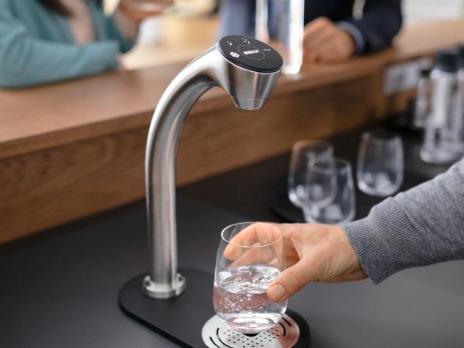
BRITA’s range covers freestanding water dispensers, countertop models, and integrated tap solutions, giving facility managers the flexibility to match the right unit to each location. All models are mains-fed, capable of dispensing up to five water types, and backed by the same end-to-end service model regardless of which product is selected.

Office Environments: What to Prioritise

In a corporate office setting, the primary considerations are reliability, ease of use, and energy efficiency. A dispenser that requires frequent staff intervention, to refill, reset, or troubleshoot, adds unnecessary burden to your facilities team and creates frustration for the employees using it. The best office water dispensers operate quietly in the background: always available, always consistent, and requiring attention only when a scheduled service visit is due.

For multi-floor offices, the placement strategy matters as much as the product choice. High-footfall areas such as kitchen zones, breakout spaces, and reception areas each have different usage patterns, and matching the right dispenser model to each location reduces queuing, improves user experience, and ensures the equipment is not being used beyond its intended capacity. Smart standby modes help manage energy consumption during quieter periods without compromising availability when demand picks up.

Hotel and Hospitality Environments: Different Demands, Same Standard

A hotel water dispenser operates in a more visible, reputation-sensitive context than its office equivalent. In a hotel lobby, conference suite, or staff corridor, equipment downtime is immediately noticeable, and the reputational cost of a water point that is out of service during a conference or a busy check-in period falls directly on the property and the facility team managing it.

Hospitality environments also tend to require greater aesthetic integration. A freestanding unit that suits a corporate breakout room may not be appropriate for a boutique hotel lobby, where an integrated tap solution offers a cleaner, more considered appearance. BRITA's range addresses both requirements, with configurations available that balance performance with presentation.

For hotel procurement teams managing multiple properties or mixed-use venues, the advantage of a single supplier relationship, covering installation, hygiene maintenance, and ongoing support across all sites, cannot be overstated. It reduces the number of supplier relationships to manage, standardises the service experience, and creates a single point of accountability when issues arise.

One Partner, End to End

Operational complexity is one of the most consistent frustrations reported by facility managers managing water provision across multiple sites or supplier relationships. When something goes wrong, a dispenser fault, a hygiene query, a filter that needs replacing ahead of schedule, the last thing you need is to be passed between a manufacturer, a third-party service contractor, and a parts supplier before anyone takes ownership of the problem.

Installation, Maintenance, and Support Under One Roof

BRITA operates a fully integrated service model, handling installation, scheduled maintenance, system sanitisation, filter replacement, and ongoing customer support through its own trained engineers, not third-party contractors. This distinction matters in practice. An engineer trained through BRITA’s in-house Service Academy understands the specific equipment they are working on, follows consistent protocols, and represents a single accountable supplier relationship from day one.

In London, BRITA operates a dedicated fleet of walker engineers, a model designed for high-density urban environments where rapid response and site familiarity are particularly valuable. For facility managers overseeing city-centre offices or hotel properties, this translates into faster resolution times and a service team that knows your sites.

Beyond the engineer model, BRITA also builds reliability into the equipment itself. PureProtect helps reduce stagnation, smart BRITA Firmware on hot water systems predicts filter expiry, and the Digital Product Assistant Tool enables fast diagnostics for simple issues that can often be resolved without waiting for an engineer. BRITA’s Dedicated CX Team also gives customers a direct, knowledgeable route for day-to-day support. The result is a more controlled service experience with fewer avoidable interruptions and clearer accountability throughout the life of the system.

Support is available Monday through Friday, with scheduled maintenance visits built into the service contract rather than arranged on an ad hoc basis. For facility managers whose value lies in keeping operations smooth and clients satisfied, that simplicity is not a luxury; it is the standard you should expect from any commercial water dispensers partner.

Find the Right Water Dispenser for Your Business

Every commercial environment has different requirements, and the right water solution is the one that fits yours, not a generic recommendation. BRITA offers a full range of mains-fed commercial water dispensers backed by an end-to-end service model, flexible buy or rent options, and consultative support to help you make the right decision for your sites. We listen to your needs and find the right solution for you.

Explore the full range of office water dispensers or contact our water dispenser team directly to discuss your specific requirements.

Frequently Asked Questions

What are the most common problems with a water dispenser for office use, and how can they be avoided?

The most common issues facility managers encounter include equipment downtime, inconsistent water temperature, and hygiene lapses between service visits. BRITA dispensers address all three: mains-fed connections remove bottle-swap disruption, while automated thermal disinfection via ThermalGate keeps hygiene maintained between engineer visits. With scheduled maintenance carried out by BRITA's own trained engineers, problems are identified and resolved before they affect your operation.

Is a water dispenser worth it for a business compared to bottled water or traditional coolers?

For most commercial environments, yes. A mains-fed water dispenser for office use eliminates the recurring cost, storage space, and carbon footprint associated with bottled water delivery. BRITA systems reduce carbon footprint by up to 86% versus bottled water, while giving employees access to up to five water types from a single, low-maintenance unit. The result is a smarter spend with fewer moving parts for your facilities team to manage.

How hygienic are office water dispensers, and what certifications should I look for?

Hygiene is a legitimate concern in any shared workplace water point, particularly in high-footfall environments. BRITA focuses on automated hygiene protection that fits day-to-day UK commercial use. ThermalGate, which comes as standard on BRITA systems, automatically disinfects the tap using heat to help keep the point of dispense safe between service visits, while PureProtect helps reduce water stagnation in the system. When evaluating any dispenser, look for clear evidence of built-in hygiene protection, documented maintenance procedures, relevant hygiene certifications where applicable, and a service model that does not rely on manual cleaning alone.

What should facility managers look for in a water dispenser service contract?

Reliability and accountability. A strong service contract should cover expert installation, scheduled maintenance, full system sanitisation, filter replacement, and responsive support, all delivered by engineers trained on your specific equipment. BRITA trains its engineers through a dedicated in-house Service Academy and operates its own service fleet, including dedicated walker engineers across London. You deal with one accountable partner from installation through to ongoing support.

Are water dispensers suitable for hotels as well as offices?

Yes, though the requirements differ. A hotel water dispenser must perform consistently across high-traffic areas such as lobbies, conference suites, and staff rooms, where downtime is visible and reputationally costly. BRITA's range includes countertop water dispensers, freestanding, and integrated tap solutions designed for varied hospitality environments, all backed by the same end-to-end service model. For hotel procurement teams, the key advantage is a single supplier relationship covering installation, hygiene maintenance, and ongoing support.

Can a mains-fed water dispenser handle the demands of a large office or hotel?

Mains-fed dispensers are built for continuous, high-volume use, making them well-suited to busy commercial environments where demand fluctuates throughout the day. Unlike bottled coolers, there is no risk of running out of supply or requiring manual refills. BRITA's floorstanding and countertop models dispense up to five water types on demand, and smart standby modes ensure energy efficiency during quieter periods without compromising availability at peak times.

What are the sustainability benefits of switching to a mains-fed office water dispenser?

Switching from bottled water to a mains-fed water dispenser for office use can reduce your carbon footprint by up to 86%, a meaningful figure for businesses with active ESG commitments. BRITA systems use natural R290 refrigerant, incorporate smart standby energy modes, and are manufactured in Europe, supporting both environmental and supply chain transparency goals. For facility managers under pressure to demonstrate green credentials, this is a straightforward, evidenced win.

How do I choose between buying and renting a commercial water dispenser?

The right model depends on your budget structure, contract flexibility, and how much operational responsibility you want to retain. Renting typically bundles equipment, maintenance, and support into a single predictable cost, reducing capital outlay and simplifying lifecycle management. Buying suits organisations that prefer asset ownership and have in-house capacity to manage servicing. BRITA offers both buy or rent options for water dispensers, with tailored consultation to help facility managers identify the best fit for their procurement requirements.

Related content

Invisible Waste Small Teaser (Mobile) - 464x348

Almost half of businesses leave equipment on overnight

BRITA's new campaign uncovers how much energy and money businesses potentially waste by leaving their equipment on overnight and provides essential insights to help businesses cut energy usage across three key sectors – Corporate, Hospitality and Healthcare.

BRITA - Gym Cycling (880x880)

How To Choose The Ideal Water Dispenser For Your Gym

From installation to water types, see our suggestions on why choosing to install a water dispenser in your gym environment.

2021_BRITA_Extra_C-Shape_small_tap_glas_710x400

Healthy office, healthy mind: promoting wellbeing with your office facilities

“Research shows that happy staff really are better staff. If businesses ensure they are creating a positive environment for their staff, they’ll reap the benefits"